

Content


Meta information helps search engines quickly understand a page's content, purpose, and display rules in search results. Some of these elements are not visible in the content but affect the snippet, indexing, click-through rate, and technical health of the site. This is precisely why working with title, description, robots, and canonical is not a minor adjustment, but a fundamental stage of SEO optimization.
Meta tags are service elements within HTML code that transmit important information about a web page to search engines and browsers. They help explain the document's topic, indexing rules, desired description in search results, and its relationship to the canonical URL version. This is precisely why meta tags are not just a hidden technical block, but a tool for managing a site's visibility in search.
Meta tags are typically placed in the <head> section of an HTML document, where service data for browsers and search engines is stored. Users do not see them as regular text while browsing a site. Search engines, browsers, and social platforms read this data when processing a web document.
Users don't see meta tags directly on a website, but they often see the results of their work in Google's search results. The title can form the heading of the result, and the description can provide a short summary below it. This is precisely why meta tags are part of a user's first contact with a site, even before they click through from the search results.
Meta tags perform various functions, so they shouldn't be viewed as a single, universal element. Some help form the snippet, others manage indexing, or indicate the primary URL version to the search engine. For SEO, title, meta description, robots, and canonical are most often analyzed, as they specifically help search engines process content correctly.

The title helps search engines quickly understand what a specific URL is about. It also often forms the heading of the search result, thus influencing the user's first impression. If the title is unclear or duplicated, the page may lose some clicks even with good rankings.
The Meta Description acts as a brief summary of a web page in search results. It is not a direct ranking factor, but it can influence CTR by helping users decide whether to click. A good description highlights the content's value without becoming a mere collection of keywords.
The Robots meta tag allows you to control how search engines should process a specific URL. Through this tag, you can permit or prohibit indexing, and also define behavior regarding links. It is especially important for utility, duplicated, test, or technically weak web pages.
Canonical helps specify the primary version of a URL if a site has similar or duplicate URLs. This is important for catalogs, filters, pages with parameters, and content that can be accessed via multiple addresses. A correct canonical tag helps prevent SEO signals from being diluted among duplicates.
Here's a basic example of what HTML meta tags might look like in code:
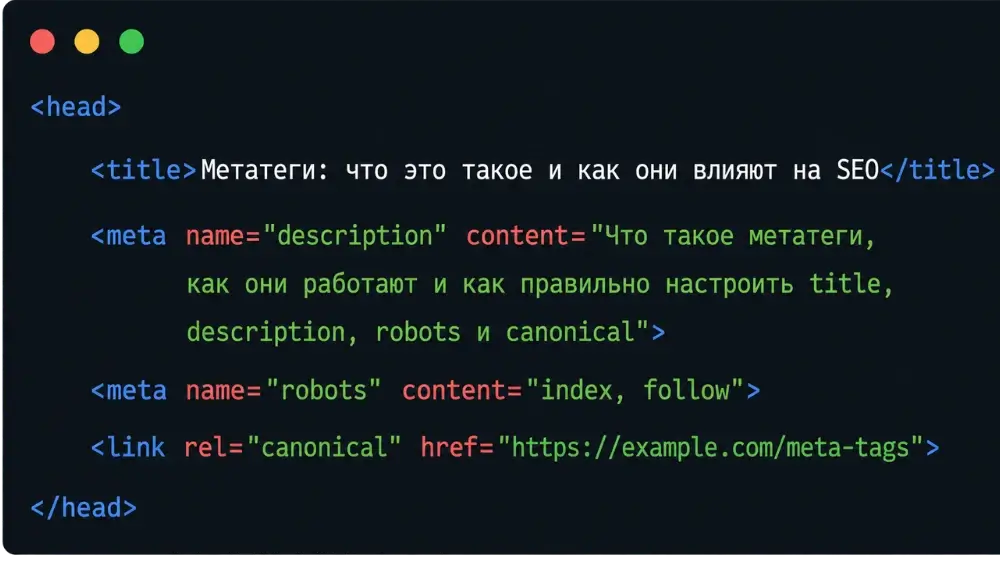
This example shows the basic structure that most SEO-optimized web pages have.
The main elements should be checked in the following order:
After such a check, it's easier to understand if the page is ready for further SEO optimization.
It's best to start checking meta tags with the title, as it's directly related to the web page's topic. A good title combines relevance, clear benefit, and natural inclusion of the key query. If it's templated or doesn't match the content, the web resource may lose clicks in search results.
The title helps Google understand what the content is about and for which queries it should be displayed. It doesn't work in isolation but together with the content, headings, internal links, and overall URL relevance. That's why the title must accurately reflect the content, not just contain a keyword.

Canonical helps consolidate signals from URLs that have identical or nearly identical content. It doesn't remove duplicates from the site but shows the search engine the preferred primary address. This allows SEO signals to concentrate on the correct URL instead of being dispersed among several content versions.
A common mistake is pointing canonical to an irrelevant page or automatically directing all URLs to the homepage. Another problem arises when canonical contradicts internal links, sitemap, or the actual site structure. In such situations, Google may ignore the hint and independently choose a different canonical address.
A correctly configured canonical helps avoid creating internal competition between duplicated URLs. It supports a cleaner indexing structure and makes page signals clearer for the search engine. For online stores, blogs, and sites with filters, this is one of the key technical SEO elements.
HTML meta tags often seem simple, but they accumulate many small SEO errors. These can appear after site migration, mass page creation, template changes, or automatic metadata generation. If these elements aren't checked regularly, the site gradually loses its technical integrity and some of its organic potential.
Duplicate titles and descriptions prevent search engines from distinguishing between URLs. If dozens of addresses have identical metadata, they appear less unique and less effectively convey their topic. This problem is particularly common in catalogs, filters, pagination, and templated service sections.
Overly long titles and descriptions may be truncated in search results, preventing users from seeing the main point. Excessively short metadata also performs poorly, as it doesn't provide enough context for choosing a result. The optimal approach is to briefly explain the page's topic, its benefits, and how it differs from other results.
If the title lacks the main keyword, the page demonstrates weaker relevance to the search engine. However, keywords should be naturally integrated, without artificial repetition or stuffing. Meta tags should function as a clear description of the web page, not as a collection of SEO phrases.
If the title or description promises one thing, but the page delivers something entirely different, users quickly lose trust. Such a mismatch can reduce the effectiveness of organic traffic, even if rankings temporarily remain good. This is why metadata should be checked in conjunction with content, structure, and search intent.
Before publishing or conducting an SEO audit, it's worth going through a short checklist:
This checklist helps quickly identify fundamental issues before they impact site visibility.
Meta tags don't promote a website on their own, but they create the technical foundation without which SEO performs less effectively. When titles, descriptions, robots, and canonical tags are systematically configured, Google better understands pages, and users can more quickly evaluate results in search. If you need to check metadata, indexing, and the technical structure of your website, the Locomotive Digital team, as part of its SEO audit service, can help identify weaknesses and turn technical adjustments into a clear growth plan.
AI website audit
Enter your website address and get results instantly.

Request a free audit — our expert will prepare a personalized action plan.
Your data is securely protected