




SEO site analysis: what is SEO Checker and why do you need it
SEO analysis of a website through SEO Checker helps you quickly understand the condition of the resource and what errors prevent it from performing better in search. We use this tool as a primary diagnostic: it shows technical weaknesses, problems with metadata, page structure, and accessibility to Google. This format is convenient when you need to get an understandable guide without complicated terms and lengthy preparation.
SEO Checker is suitable for business owners, marketers, content specialists, and teams who want to see specific signals rather than general guesswork. It is not a substitute for an in-depth audit, but it helps to quickly identify where the site is losing potential. After verification, it is easier to understand which tasks can be completed immediately, and where a full SEO audit is already needed.
SEO site check: what exactly does the tool analyze
SEO site verification covers basic parameters that affect page visibility, indexing, and quality. We look not only at individual errors, but at the big picture: how the page responds to the search engine, how clearly the content is designed, and whether there are any technical restrictions. This helps to quickly separate critical issues from secondary concerns.
Technical SEO parameters
The tool checks the status code, HTTPS, basic redirects, response speed, and page availability. It is also important to see if there are any errors that prevent the crawler from processing URLs normally. If the technical basis is weak, even well-written text may not reach its potential in search.
On-page page elements
The on-page block shows how well the page explains its topic to the user and Google. We analyze title, description, H1-H3, alt-attributes, internal links, and basic content structure. Such an analysis of the SEO site helps to understand whether the page has a clear focus and whether it is sufficiently prepared for promotion.
Indexing and search availability
Even a useful page may not receive traffic if it is closed from indexing or incorrectly indicates canonical. That's why we check meta robots, robots.txt, sitemap, and other availability signals. If Google can't see the content correctly, the rest of the improvements will work weaker.
SEO Checker helps you quickly check key elements:
- title, description and main H1;
- status code, HTTPS, and basic redirects;
- robots.txt, canonical and meta robots;
- header structure and internal links;
- alt texts, images, and media file weights;
- download speed and basic technical signals.
After such an initial cut, it becomes easier to understand where the most noticeable growth points are.
Online SEO site analysis: how verification works
Online SEO analysis follows a simple logic: you submit the URL, we run the check and get a list of problems found. Then it is important not only to see the errors, but to read them correctly. The same indicator can be critical for a large catalog and has almost no effect on a small landing page.
The process usually looks like this:
- You submit the address of a website or an individual page.
- We are testing the main SEO parameters.
- We record errors that may affect visibility.
- We share quick fixes and tasks for more in-depth analysis.
- We explain which steps should be taken first.
This approach helps you avoid wasting time on chaotic edits and quickly move on to actions that really make sense.
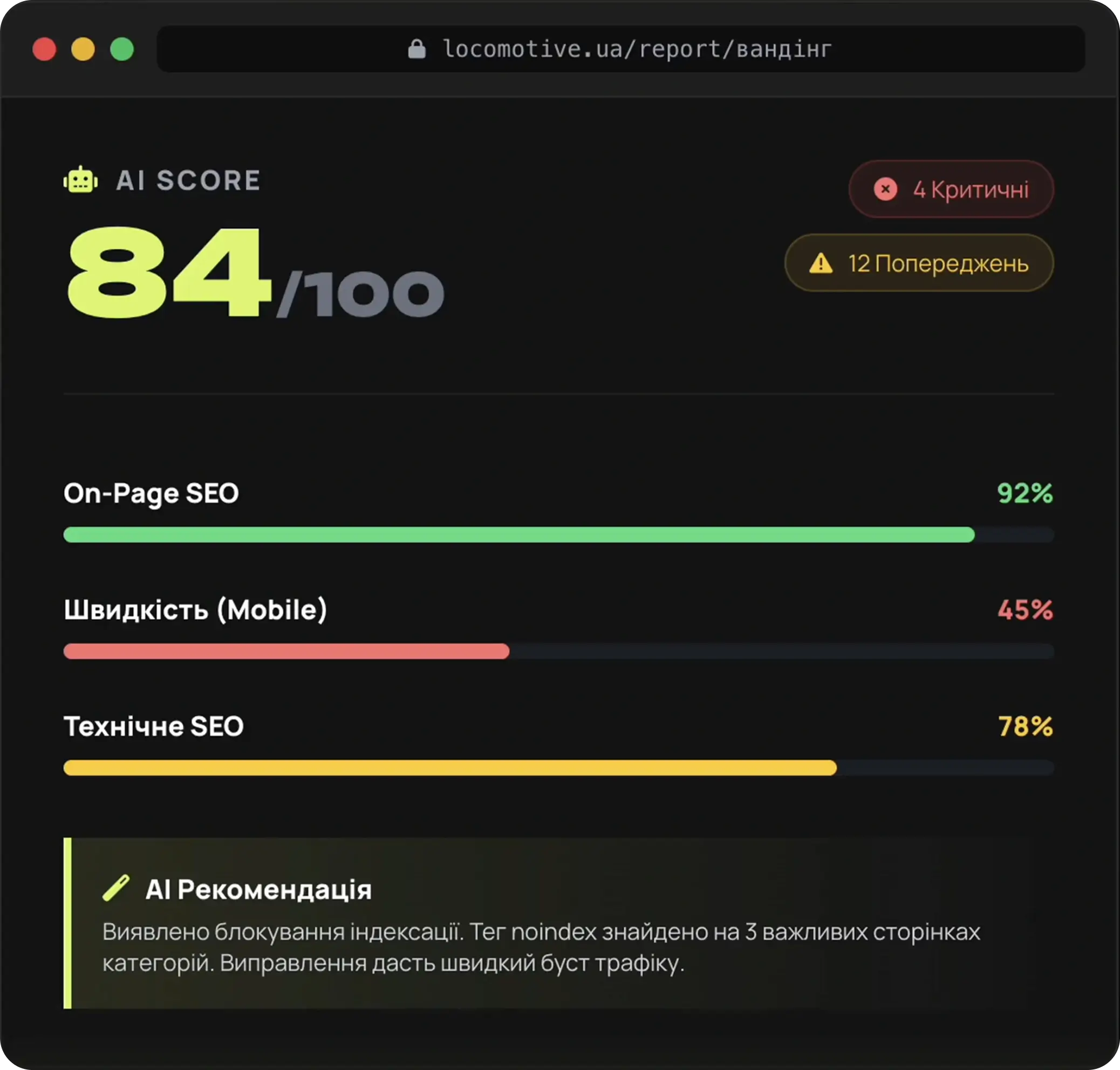
An example of a mini-report after verification
Below is a conditional example of what the result of the initial diagnosis might look like:
The mini-report provides a quick reference point, but for complex projects it should be supplemented by a manual assessment of the structure, semantics, and competitors.
Checking a website for SEO optimization: what mistakes does SEO Checker help to find
Checking a website for SEO optimization is especially useful when the resource is already full of content, but organic traffic is not growing. Often the problem lies not in one big mistake, but in a set of small flaws. We help you see these weaknesses and understand which ones should be addressed first.
Errors in meta tags and titles
Title, description, and H1 should clearly explain the topic of the page. If they're empty, duplicated, or too general, it's harder for a search engine to understand the purpose of the content. SEO analysis of the site page helps you quickly see such problems and prepare edits.
Technical page issues
Technical issues include broken links, incorrect redirects, slow loading, mobile display errors, and heavy images. Checking the site's SEO allows you to see such shortcomings before they start to have a greater impact on promotion. It is especially important to check template pages because one mistake can be repeated on dozens of URLs.
Bugs that affect visibility on Google
Sometimes a page looks normal to the user but is poorly processed by the search engine. The reason may be noindex, incorrect canonical, poor linking, or closing important sections via robots.txt. This SEO analysis of a website helps to find restrictions that prevent the resource from getting more organic traffic.
Online SEO website audit: how does a checker differ from a full audit
An online SEO audit in the format of an automatic check gives quick results, but does not replace expert work. The checker shows basic errors, and a full audit explains how they relate to structure, competitors, semantics, landing pages, and business goals. That's why we consider SEO Checker as a convenient first step rather than the final solution to all problems.
If you need a full SEO analysis of your site, it is better to combine automated diagnostics with manual expert assessment. This way you get not just a list of bugs, but a clear plan for improvements.
Online SEO site audit for free: when checker is no longer enough
An online SEO audit for free can be a good starting point if you need to quickly check for obvious issues. But when a site loses ground, doesn't grow for important queries, or receives traffic without applications, simple verification is not enough. In such cases, an in-depth analysis of the technical part, structure, content, competitors and search demand is required.
An analysis of SEO website promotion helps to understand not only the state of the pages, but also why the resource does not achieve the desired result. Sometimes the problem is technical errors, sometimes it is a problem with poor semantics, wrong landing pages, or a lack of a clear structure. Therefore, we do not limit ourselves to mechanical testing if we see that the project needs systemic optimization.
Website SEO optimization analysis: when to contact us
An analysis of SEO website optimization is needed if you want not only to see errors, but to understand how correcting them will affect visibility and requests. We help you read the test result, identify critical tasks and avoid wasting resources on edits that will not have a noticeable effect. This approach is especially useful for sites that already have traffic, but the organic channel is weaker than it should.
Before contacting specialists, you should evaluate several features:
- positions are not growing, although the content is regularly updated;
- pages are in the index, but they get few impressions;
- organic applications are unstable or almost non-existent;
- after the changes on the site, traffic dropped;
- the automatic report shows a lot of errors, but it's not clear what to fix first.
If you find out your situation in these points, it is better not to delay the test.
SEO Checker helps you quickly see the starting picture: technical flaws, weak on-page elements, and possible indexing restrictions. But a strong result comes when these checks turn into understandable actions. Submit a request to Locomotive Digital — we will conduct an initial analysis, explain the results in simple language and offer an SEO audit that will show you how to strengthen the site systematically, rather than with random random edits.